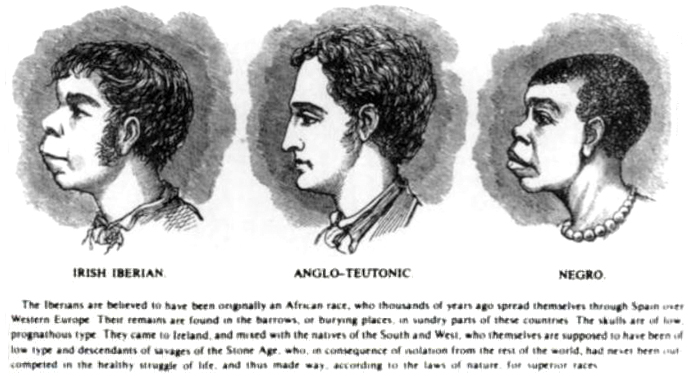

As you probably know A long time ago people did not think the Irish and your kind were white. I guess some people still think like this and need clarity about colors.
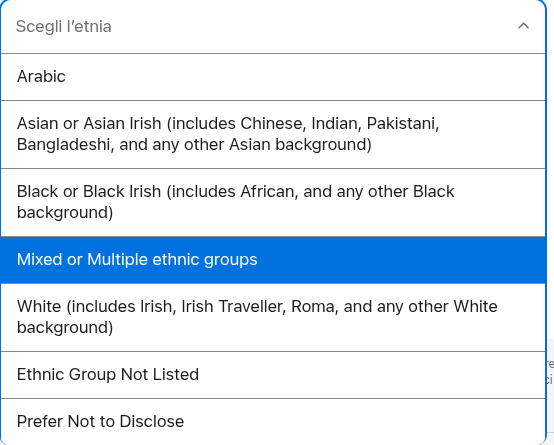
"includes Irish" is fucking wild, wtf???????
this is literally Apple's website btw


It wasn't as much as they called the concept "white" but it's the closest modern equivalent. Catholic immigrants were simply considered subhuman, not because of their skin colour but because of their religion and poverty. From plebbit:
>"Italians/Irish/Poles weren't considered white" is a popular way of describing the complicated situation in the 19th and early 20th centuries. There's even a book titled How the Irish Became White! However, this framing is presentist: today, most Americans (not so much Europeans) tend to see ethnicity and "race" as equivalent, with the options being "white", "Black/African-American", "Native American/Indian", "Asian", etc. In order to get the modern American to see that Catholic Italian immigrants were not seen as being on the same order as Protestants with English ancestry, then, it's easy to say that Italians "weren't considered white". But this upholds our modern, American ethnic/racial distinctions as objectively real.
>The earliest Irish immigrants to America tended to be Protestant, mainly "Scots-Irish" from Ulster; various English-American colonies actively sought Irish Protestant immigrants to come in and start independent farms while snubbing or actively disallowing the Catholics. For instance, South Carolina was officially an Anglican colony, but gave protections to the Scots-Irish who were part of the Church of Scotland. And it wasn't just Irish Protestants - Queen Anne of England promised land to any German Protestants who wished to settle it, prompting a mass movement of poor families from the Palatine region to London and then eastern-central New York. Increased Irish Catholic immigration came during the potato famine of the 1840s, and there was a fresh wave of German immigrants as well - not spurred so much by the revolutions of the late '40s, but because they were also affected by the potato blight and wanted to escape poverty. (About 1/3 of these German immigrants were Catholic themselves.) Italian and Polish immigration mainly started in the last quarter of the century, and likewise involved mainly Catholic rural laborers from poor areas, coming with very little besides themselves. Most ended up living in tenements, working in factories or sweatshops or as laborers in construction projects, which in and of itself would lead middle- and upper-class America to look down on them.
>Americans with English heritage, often descended from pre-Revolutionary colonists or from immigrants from early in the 19th century, saw themselves at worst as the default, and at their most self-aggrandizing, a superior form of humanity. Protestant > Catholic, and certain flavors of Protestantism were better than others. Northern Europe > Southern Europe; Western Europe > Central or Eastern Europe; England > Scotland > Ireland. Stereotypes of these white immigrants abounded, usually depicted with painful eye-dialect in writing or in thick accents on the stage; they wouldn't always be written as negative characters, per se, but the humor came at the expense of how Other they were from "normal" Americans. And things got uglier with the Know-Nothing movement, a nativist group/party that organized against immigrants because "they're lazy", "they're taking jobs", "they're outnumbering good Anglo-Saxon stock", and the other xenophobic fears that certainly were not confined to that one moment in time. Newspaper ads did indeed discriminate, as discussed by u/sunagainstgold here, on the basis of origin and religion, because the ideal and most prestigious servant was white, English, and Protestant. (Many had to compromise. The stereotype of the Irish cook or housemaid was quite prevalent.)
>However, while some did make statements equating the Irish and African-Americans in the early 19th century (largely before large-scale immigration from other countries), there was a very solid difference between black Americans and any European immigrant groups: slavery. As u/freedmenspatrol discusses very adeptly in this answer, the entire concept of being a free white man required the opposition of the unfree state, resting on the real or theoretical ability to enslave black men, women, and children. Pre-Civil War, no matter how poor any immigrant from Europe was, they were still "free". Even after the Civil War, the ideology persisted.
>Because what "become white" means in this case is that the way white ethnicity was perceived changed. Immigrant groups - first the Irish and Germans, then the others - made inroads into local government and started their own businesses, changing the narratives around their stereotypes and taking power. They became acculturated, holding onto their ethnic identities while learning to navigate America, and gradually an individual's parents' country of origin within Europe meant less to outsiders. Whatever place in Europe your family had come from, in the United States you could be just another white person after World War II, though some stereotyping would persist. It's not a coincidence that this happened as organized protest about the status of African-Americans began to rise, setting up a more important dichotomy than English-American vs. Irish-American vs. Italian-American.
>Some sources you might be interested in, though I referred to others as well in writing this:
>The Irish Way: Becoming American in the Multiethnic City, James R. Barrett (2012)
>Nativism and Slavery: The Northern Know Nothings and the Politics of the 1850's, Tyler Anbinder (1992)
>Polish Refugees and the Polish American Immigration and Relief Committee, Janusz Cisek (2006)