


I can't wait to be a neo reactionary defending big agro interests and immigrant fueled soy farming while indians now build apple phones with precision manufacturing.
What do you think about neoreaction (NRx)?
I haven't seen any neoreactionaries in LatAm who promote market liberalization, financing, and the liberalization of the tech industry. Only defenders of conservatism, that is, classical conservatives. Are there any in your country?
https://en.m.wikipedia.org/wiki/Dark_Enlightenment
https://legrandcontinent.eu/es/2025/06/28/atlas-del-pensamiento-neorreaccionario-una-primera-bibliografia-razonada/
Also:
I'd like a future where AI is like an oracle or a genie, where you can cure diseases and extend lifespans. Also, where we can enhance cognitive abilities and expand consciousness.
That's the irony and supposedly contradictory aspect of the neo-reaction. While it defends techno-nationalism, its industrialization is global (globalism). In reality, this is a logical consequence, because for Elon to create his Teslas (promising the creation of robo-cars, i.e., the top of the market) in the US, he has to extract lithium from Peru and Argentina, buy chips from Taiwan, etc.
What differentiates the neo-reaction from the old reaction is that the staunch defense against globalism is lost, at least in essence. And since the Tradition of Modernity cannot be saved, it must be reformulated (a Christian homosexual is preferable to a woke homosexual).
Example: https://en.m.wikipedia.org/wiki/LGBTQ_conservatism
Also:
This also saves the traditional view of law: the freedom of the individual based on their personhood, not their sexuality.



>too many difficult words very hard
Yes, I understand. If one looks at the hard-core thinkers of the movement, one finds terminology that is as technical as it is cryptic (sometimes deliberately cryptic to provoke self-marginalization). There are also those who merge essay writing with fiction, that is, they argue using fictional analogies (like Descartes speaking of the evil genius or Alcubierre theorizing about quasi-luminous journeys).
But there are certain generalizations:
>Capitalism does not succumb to its contradictions (disruption, extreme impoverishment, structural inequality), but rather feeds on them (it generates development and innovation, the welfare state, and social justice by reaction).
>Capitalism must be pushed to its limits by developing the technology of the means of production.
>Technoscience generates new transhumanist or posthumanist potentials through biotechnology and cybernetics.
>Economic changes bring with them cultural changes and vice versa (public policies and private ideological projects - political agendas - lead to technoscience, favoring some lines of research over others).
>What are some of the advantages of this ideology and tye way of life it promotes
Neoreaction dialectically transcends the cultural war between progressives and classical conservatives. It is hyper-individualistic, but understands that Tradition cannot survive Modernity without being modified. In this, it surpasses classical conservatives, who, in a sense, are like hobbits fighting an invincible Sauron. It does not advocate anti-globalist nationalism, but rather relative national sovereignty (globalization is an irreversible phenomenon), so what must be produced at home will be produced at home. But what must be brought in from outside will be brought in from outside (it exchanges patriotic defense for realpolitik).
At the same time, it devastates the identity issue; the foundations of transhumanism change the paradigm. It's not about gender or sexual life (this is a thing of the past. Just as the identity struggle eclipsed the class struggle, the transhumanist-posthumanist struggle is on its way to eclipsing the identity struggle), but about vital modifications and physical and mental improvement (for example, cryopreserving your sperm to have children after death; following exercises, diets, and taking supplements and medications that extend life; the possibility of driving the development of CRISPR to modify genes that produce or accelerate aging or various diseases).
The wealthy classes will be the first to reap the benefits, but it's debatable whether there can be no intervention. In the accelerationist world, the socioeconomic dispute will be between the free market (private initiative) or dirigisme (public-private initiative). Neo-Keynes vs. Neo-Hayek.
So its benefit lies in its syntactical capacity. What's the point of clinging to ideologies that are dying because they can't adapt to the global economy or the technological disruption of the means of production?

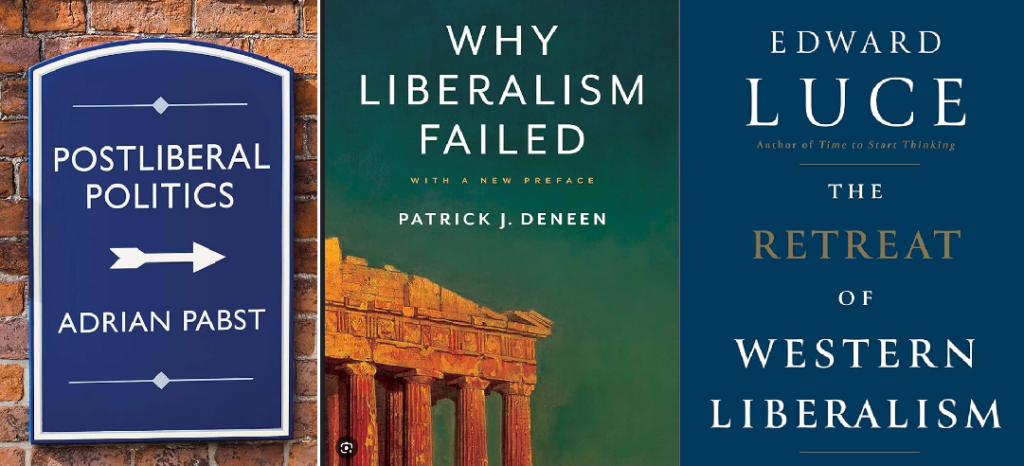

>Not exactly but since Orbán and co. takes us back to feudalism, sure, why not
I'd say the opposite. And how ironic, Bernd! Just a few days ago, I was reading about post-liberalism and came across Orbán's name as a current example of a post-liberal government.
https://en.wikipedia.org/wiki/Postliberalism
>But (attention)
Post-liberalism is just as reactionary as socialism. From the accelerationist perspective in general (including NRx). Why? Because: It doesn't extend capital to its fullest extent, but rather seeks to "salvage" its contradictions through communitarian methods (economic inequality with state intervention and social movements—the welfare state and unions—and social division with a sense of belonging and identity and a sense of duty—patriotism, religion, and morality).
But for accelerationists, these are either resources assimilated by capitalism or they are obstacles in the way of a never-ending cycle.
>Opposite of which part?
That Orbán is trying to return to feudalism. In reality, his government could be the first post-liberal government in history, but naturally it will be alone. Like Bukele in El Salvador.
Post-liberalism seeks to preserve community without the market degeneration that underlies the logic of capitalism (improving the means of production to the point of overflowing consumption—among those things, the most marketable or consumable narratives like "women's emancipation" or "sexual freedom"). But there isn't a strong community of post-liberals in the world. Orbán is fighting against globalist elites and, probably, against leftist reactionaries within his own country (who are anti-liberal, but also anti-conservative) and liberal reactionaries (who see conservatism only as instrumental).
See:
https://en.wikipedia.org/wiki/Rainbow_capitalism
https://en.wikipedia.org/wiki/Feminist_capitalism
https://www.illiberalism.org/illiberalism-and-postliberalism-comparing-ideological-ferment-in-eastern-europe-and-the-anglo-american-world/
All right I expand on feudalism a bit.
Once a very smart man called the state socialism we were building to get to communism from 1948 to 1989 a "feudal-bureaucratic pseudo-socialism". The first part is the more interesting for this post.
Feudalism is an economic, political and societal system. It is built on a chain of hierarchy, where land is handed out going from the top of society to the bottom, and in return for the land and protection the subordinate owed with fealty and service to his lord, had to give mandatory support. On each level they gave the land to their own personal loyal men cronyism.
This was the same with the bureaucratic hierarchy of the state socialism too. The top party members got their positions in the system and they are handed the positions the land, feudum, fief to their men who handed the lower positions to theirs and so on, from ministers to the pig shit cleaner of the smallest rural agricultural cooperative "cooperative". And on all levels they expected the subordinates to support and lick their arses.
The Fidesz govt. does the same. Offices and even jobs are handed out based on personal connections. Loyalty and reliability is more important than suitability, competence and talent. Those who aren't within this chain of lackeys are gonna get targeted by the others around him, with real political intrigue.
Hungary barely ever had any time to develop other ways of structuring than feudalism. The slimy culture of "your excellence" subserviency follows us since feudalism was abolished back in the late 19th.
They smother every real grassroot movements in their cradle. And this isn't done by the top guys but the vassals of the vassals on the level where the root would sprout. No the opposition movements aren't grassroot.
Anyway.
>Orbán is fighting against globalist elites
He does not. This conservative wave is as globalist as the leftliberal. In some ways he is promoting more globalist positions: in the EU leftlibs are weakening the states, to integrate them more into the common EU market, but when Orbán says we should not allow that and we have to trade with everyone from US through South Africa to China... which means picking the more globalist market.
The reality is already global. Many people still live in their nation state mindset and this is what these "conservatives" play on to get into power. They give them the rhetoric because voter base votes on this. This is called populism btw. They still serve the same international mammon, because that is really what keeps them in power. Hungarian market is chiefly for the multi-companies this is the case with all the markets of all the countries, there is a small section of it for the local oligarchs to fight over it.
Even if Hungary were "backward," it isn't truly feudalistic (at best, it's an underdeveloped European country). If that were the case, LatAm would be feudalistic because there is more trade with the latifundia than in the provision of services, but even that doesn't define feudalism. I think you have a misconception when you talk about the "cronyism" (oligarchs) that exists in your country and reduce feudalism to mere social stratification, and don't address the true reason that differentiates it from the capitalist system and its forms of production. But if we're going to be serious, then let's talk about how the fief system works (otherwise, we're using the word gratuitously).
What differentiates feudalism from capitalism (systems) isn't just social stratification or mobility. In genuinely economic terms, it's something more essential: feudalism operates on the basis of fief rent (which is the land on which people work—usually serfs—and consequently produce). What defines capitalism are the means of production (capital) and its counterpart, labor. But let's focus on what matters: capital. There are businesses operating in Hungary (even the state itself, through its organs); the mere fact that they exist contradicts feudalism, because what defines businesses is the private ownership of the means of production (although this mixed economy also allows for state capitalism). The fact that there are oligarchs in Hungary doesn't make a difference; capitalism isn't contrary to oligarchy per se (the children of businessmen and investors inherit their parents' shares).
Just think: There's also favoritism, cronyism, clientelism, and oligarchy in the US. Since when does that make the US a feudal country...? There were also these in the USSR, and that didn't make it feudal. In fact, in the USSR, there was very low social mobility due to favoritism and partisan clientelism, but the USSR was a case of state capitalism.
In any case, Hungary is an underdeveloped state and has high levels of systemic corruption.
https://en.wikipedia.org/wiki/Hungary#Economy
https://en.wikipedia.org/wiki/List_of_companies_of_Hungary
https://www.britannica.com/topic/feudal-land-tenure
https://www.worldhistory.org/Feudalism/
>Hungary barely ever had any time to develop other ways of structuring than feudalism. The slimy culture of "your excellence" subserviency follows us since feudalism was abolished back in the late 19th.
>feudalism was abolished
They abolished it, but they didn't abolish it.

Okay. Let's start from the premise that the phenomenon of globalization cannot be avoided. But globalism (-ism) as an ideology promotes that all exports and imports (necessary or not) are good because the free market is good for material development in general (the economic specialization thesis). The question I ask myself is: Does Orbán differentiate between necessary and unnecessary exports/imports? (Using unnecessary as any import and foreign capitalization that can be reproduced locally. For example, if a plantation or some type of commodity can be produced in Hungary, then its import is not necessary, nor is foreign capitalization because whatever it is, it can be produced by a local organization—public or private enterprise).
That is what defines whether Orbán is a globalist or not in post-liberal terms. Because that's what progressives and liberals do, and they are criticized for it (both of whom accept globalism in its ideological sense, that is, they don't recognize globalization as an economic phenomenon, but rather actively promote it for deliberate economic development).
In the case of accelerationists, it's a little harder to define because there's a conflict between commodities and technological development. On the one hand, they admit the need for the exploitation of raw materials at a global level, but they seek technical development in terms of techno-nationalism (digital sovereignty = national sovereignty).
>There's a small section of it for the local oligarchs to fight over it.
Okay. That's inevitable; businessmen and politicians capitalize on it. In Uruguay, the former president's family owns properties in the eucalyptus plantation, which is where the pulp for the Finnish company UPM is extracted. UPM opened two factories in Uruguay, the first with the approval of leftist governments and the second under the former president. There are similar examples all over the world, and it's part of the favoritism we've been discussing.
Unrelated pic, but it made me laugh.


>I would love to look into how the nations psyop each others' population, it seems to be a phenomenon many people aren't accounting for
That reminds me of a recent case in LatAm:
https://medium.com/@anaclaudiapaixao/russian-espionage-in-brazil-the-real-life-version-of-the-americans-10ae05c4024f
Or
YouTube: M3yV8L3s7QQ?si=EC2rAgsyKFgS-NMf